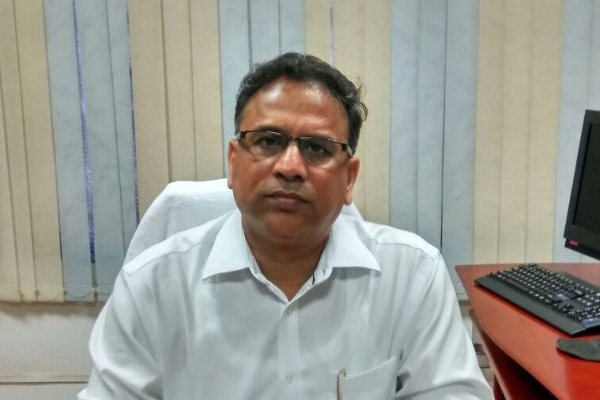
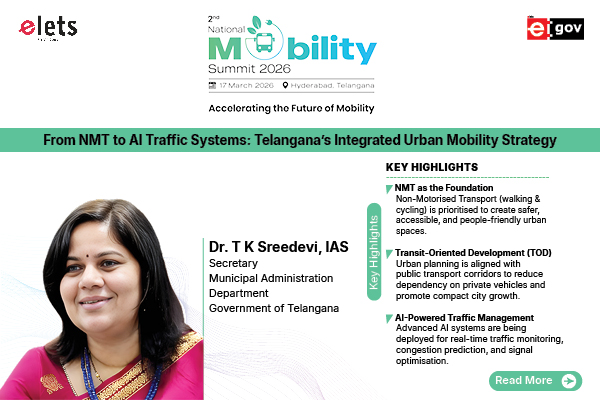
From NMT to AI Traffic Systems, Dr. T.K. Sreedevi, IAS, Secretary, Municipal Administration Department, Government of Telangana, shares with Rose Jaiswal from Elets News Network (ENN), how Telangana’s Municipal Administration Department is integrating sustainable, multimodal, and gender-inclusive mobility into city planning frameworks across Urban Local Bodies.
Telangana has been proactive in urban transformation. How is the Municipal Administration Departments integrating sustainable and multimodal mobility into city planning frameworks across ULBs.

We have been actively encouraging Urban Local Bodies in Telangana’s secondary cities to adopt robust Non-Motorised Transport (NMT) frameworks as a core mobility strategy. In cities such as Warangal and Karimnagar, a significant share of daily economic exchange is driven by peri-urban and rural populations who access these urban centres for small-scale trade, services, and informal market activities. Much of this intra-city movement, both by visiting traders and resident populations, occurs on foot. Strengthening pedestrian infrastructure, improving last-mile connectivity, and formalising safe NMT corridors are therefore not peripheral interventions but central to sustaining local economies and improving urban productivity.
Simultaneously, Transit-Oriented Development (TOD) models are being advanced in key regional hubs such as Warangal, Khammam, and Mahabubnagar. Given their role as primary service and employment nodes for surrounding settlements, TOD planning in these cities is being positioned not merely as a land-use strategy, but as an integrated urban systems approach. The objective is to ensure compact, mixed-use development around transit corridors, supported by high-quality public realm design, social infrastructure, economic activity zones, and multimodal integration.
Importantly, mobility patterns in Telangana are being reshaped by the state’s policy of free public bus travel for women, which is influencing modal shifts, trip frequency, and peak demand characteristics. This has significant implications for transport planning, service scheduling, station area design, and safety infrastructure. Therefore, gender-responsive mobility planning must be embedded alongside sustainability objectives. Infrastructure design, lighting, surveillance, pedestrian prioritisation, and safe access to transit nodes are being treated as essential components of an inclusive urban mobility framework. Overall, the approach integrates NMT strengthening, TOD-based spatial planning, and gender-inclusive mobility systems to create economically vibrant, environmentally sustainable, and socially equitable urban centres across Telangana’s secondary cities.
With increasing emphasis on climate resilience, how are municipal bodies aligning mobility projects with green infrastructure, EV Adoption and low carbon solutions?
Under electric mobility adoption, Telangana’s secondary cities are entering a decisive transition phase. Through the Government of India’s PM e-Bus Sewa initiative, Warangal is set to receive 100 electric buses, while Nizamabad will receive 51 buses to strengthen their intra-city public transport networks. Once operational, these fleets will significantly enhance service reliability, reduce tailpipe emissions, and modernize the overall public transport ecosystem. Importantly, in the context of Telangana’s free bus travel scheme for women, the expansion of electric bus fleets will not only improve environmental performance but also increase accessible, safe, and affordable mobility options for women commuters, thereby reinforcing gender-responsive transport planning.
Beyond fleet electrification, cities across Telangana are institutionalizing EV-readiness within urban planning frameworks. All new urban developments are being mandated to allocate dedicated space for EV charging infrastructure at the design stage itself. This proactive integration avoids retrofitting costs and ensures that charging ecosystems evolve in parallel with built-form expansion By embedding EV charging norms into planning approvals, municipalities are shifting from incremental adoption to structural transformation of urban mobility systems.
Under CITIIS 2.0, the Commissioner & Director of Municipal Administration (CDMA) is also reassessing municipal solid waste collection systems with a view to integrating electric vehicles into primary and secondary collection logistics. Electrifying waste transport fleets will reduce operational emissions, lower long-term fuel costs, and align municipal service delivery with state-level decarbonization goals.
Further strengthening the circular economy approach, Warangal is spearheading an organic waste-to-bio methanation initiative with technical support from National Institute of Urban Affairs. The bio methanation plant will process segregated organic waste to generate biogas, which will be refined and utilized as fuel for CNG-operated municipal vehicles. This model closes the loop within municipal operations, converting city-generated organic waste into clean fuel that powers service delivery vehicles, thereby demonstrating a replicable framework for low-carbon, resource-
efficient urban management.
How can AI, predictive analytics, and IoT based systems be leveraged by municipal administration to improve traffic flows, parking management and public transport efficiency in Telangana Cities?
We intend to integrate Artificial Intelligence (AI) and predictive analytics into urban traffic management systems to improve real-time decision-making and congestion mitigation. By leveraging machine learning algorithms, historical traffic datasets, live GPS feeds, CCTV-based image analytics, and IoT sensor inputs, cities can forecast traffic build-up, identify probable choke points, and simulate jam scenarios before they fully materialize. This enables traffic control centres to deploy dynamic signal timing, reroute vehicles, issue public advisories, and coordinate enforcement responses in a time-sensitive manner, thereby reducing delays and improving network
efficiency.
AI-enabled parking management is another priority intervention. Given the limited right-of-way in many urban corridors, unregulated on-street parking significantly reduces carriageway capacity. Through computer vision, smart sensors, and digital parking platforms, cities can enable real-time parking availability tracking, dynamic pricing, automated enforcement of illegal parking, and optimized space utilization. This reduces cruising time for parking, an often underestimated contributor to congestion, and enhances overall traffic discipline without requiring major road widening.
Views expressed by: Dr. T.K. Sreedevi, IAS, Secretary, Municipal Administration Department, Government of Telangana